Leetcode Unique Paths Java Solution
// SOLVING THIS WITH AN AI ASSISTANT (2026)
If you are working through this problem with an AI coding assistant — Claude, ChatGPT, Cursor chat, Gemini, GitHub Copilot, Aider, or any agent — the goal isn’t to ask for the answer. It is to use the tool to understand the pattern. The prompt sequence I’d run:
- Spec it back to me first. “In your own words, what is this problem actually testing? What’s the smallest example that fails the naive approach?”
- Brute-force first, optimize after. “Write the simplest correct solution, even if it’s O(n²). Don’t optimize. Just make it correct, with comments explaining each step.”
- Ask for the upgrade. “Now show me the optimal solution. What insight makes it possible? What pattern is this an instance of?”
- Stress-test it. “Generate 10 edge cases — empty input, single element, duplicates, max size, sorted, reverse-sorted. Run my solution against each.”
The pattern matters more than the answer. If the agent just hands you optimized code, you’ve trained yourself to lose interviews.
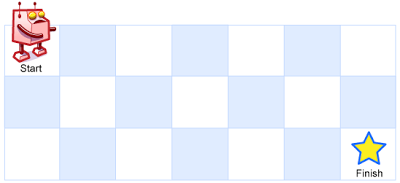
A robot is located at the top-left corner of a m x n grid (marked ‘Start’ in the diagram below).
The robot can only move either down or right at any point in time. The robot is trying to reach the bottom-right corner of the grid (marked ‘Finish’ in the diagram below).
How many possible unique paths are there?
Example 1:
Input: m = 3, n = 2
Output: 3
Explanation:
From the top-left corner, there are a total of 3 ways to reach the bottom-right corner:
1. Right -> Right -> Down
2. Right -> Down -> Right
3. Down -> Right -> Right
Example 2:
Input: m = 7, n = 3
Output: 28
Solution:
We will solve the problem using Dynamic Programming, adding the unique paths the pervious index to the left and previous index to the top and return the value in the final index.
class HackerHeap {
    public int uniquePaths(int m, int n) {
        int[][] dp = new int[m][n];

        for(int i=0;i<m;i++){
            for(int j=0;j<n;j++){
                if(i==0||j==0) {
                    dp[i][j] =1;
                }else {
                    dp[i][j] += dp[i-1][j] + dp[i][j-1];
                }
            }
        }
        return dp[m-1][n-1];
    }
}
For the AI-native engineering side of HackerHeap — building MCP servers, comparing agents (Claude Code, Cursor, Windsurf, Codex, Gemini, Copilot), and weekly working code — see the Friday Build newsletter and the MCP archive.