Java Datatypes

// BUILDING THIS WITH AN AI AGENT (2026)
Whether you are using Claude Code, Cursor, Windsurf, GitHub Copilot, Gemini Code Assist, Aider, or Cline — the productive pattern for production code in this space is: scaffold first, then ask for the idiomatic refactor. The prompt sequence:
- Scaffold. “Generate a basic working implementation. Don’t worry about elegance. Just get the happy path correct.”
- Ask for idiomaticity. “Refactor this to be idiomatic for the framework version I’m using. Specifically use [records / constructor injection / @Configuration / proper exception types / etc].”
- Test generation. “Add tests covering the happy path and 3 realistic edge cases. Use the testing conventions of the codebase.”
- Document the public API. “Add doc-comments on the public methods explaining what callers can and can’t assume.”
Agents are good at idiomatic code when you explicitly ask — they default to older patterns otherwise.
What is a Datatype?
A data type is an attribute of data that tells the compiler or interpreter how the programmer intends to use the data.
Data types in Java programming language
There are two different sets of data types in Java
- Primitive Datatypes
- Non Primitive Datatypes
The below image depicts different data types in java
The Java programming language is statically-typed, which means that all variables must first be declared before they can be used. This involves stating the variable’s type and name.
boolean: is used to store true or false value.
byte, short, int, long: is used to store whole numbers.
float, double: is used to store fractional numbers.
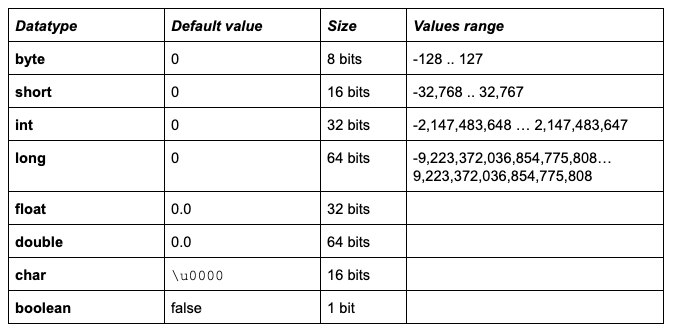
The below table depicts different datatypes and the size of those datatypes.
package com.test.java;

public class BasicDataTypes {

	static byte i = 127;
	static short j = 3456;
	static int k = 24233534;
	static long l = 34564;
	static float fl = 35325432;
	static double db = 34523763;
	static boolean b = true;
	static char c = 'c';

	static String testString = "Hello World";


	public static void main(String [] args) {
		char[] testCharString = new char[11];
		testCharString[0] = 'h';
		testCharString[1] = 'e';
		testCharString[2] = 'l';
		testCharString[3] = 'l';
		testCharString[4] = 'o';
		testCharString[5] = ' ';
		testCharString[6] = 'w';
		testCharString[7] = 'o';
		testCharString[8] = 'r';
		testCharString[9] = 'l';
		testCharString[10] = 'd';

		System.out.println("Default value of byte is ---> "+i);
		System.out.println("Default value of short is ---> "+j);
		System.out.println("Default value of int is ---> "+k);
		System.out.println("Default value of long is ---> "+l);
		System.out.println("Default value of float is ---> "+fl);
		System.out.println("Default value of double is ---> "+db);
		System.out.println("Default value of boolean is ---> "+b);
		System.out.println("Default value of char is ---> "+c);
		System.out.println("Default value of String is ---> "+testString);
		System.out.println("Default value of char is ---> "+String.valueOf(testCharString));


	}

}
Here is the video
For the AI-native engineering side of HackerHeap — building MCP servers, comparing agents (Claude Code, Cursor, Windsurf, Codex, Gemini, Copilot), and weekly working code — see the Friday Build newsletter and the MCP archive.