Leetcode 37 Sudoku Solver Java Solution
// SOLVING THIS WITH AN AI ASSISTANT (2026)
If you are working through this problem with an AI coding assistant — Claude, ChatGPT, Cursor chat, Gemini, GitHub Copilot, Aider, or any agent — the goal isn’t to ask for the answer. It is to use the tool to understand the pattern. The prompt sequence I’d run:
- Spec it back to me first. “In your own words, what is this problem actually testing? What’s the smallest example that fails the naive approach?”
- Brute-force first, optimize after. “Write the simplest correct solution, even if it’s O(n²). Don’t optimize. Just make it correct, with comments explaining each step.”
- Ask for the upgrade. “Now show me the optimal solution. What insight makes it possible? What pattern is this an instance of?”
- Stress-test it. “Generate 10 edge cases — empty input, single element, duplicates, max size, sorted, reverse-sorted. Run my solution against each.”
The pattern matters more than the answer. If the agent just hands you optimized code, you’ve trained yourself to lose interviews.
Write a program to solve a Sudoku puzzle by filling the empty cells.
A sudoku solution must satisfy all of the following rules:
- Each of the digits
1-9must occur exactly once in each row. - Each of the digits
1-9must occur exactly once in each column. - Each of the the digits
1-9must occur exactly once in each of the 93x3sub-boxes of the grid.
Empty cells are indicated by the character '.'.
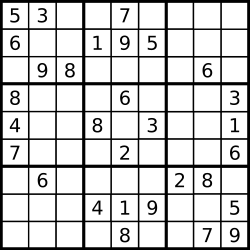
A sudoku puzzle…

…and its solution numbers marked in red.
Note:
- The given board contain only digits
1-9and the character'.'. - You may assume that the given Sudoku puzzle will have a single unique solution.
- The given board size is always
9x9.
Solution 1:
class Solution {
    public void solveSudoku(char[][] board) {
        helper(board);
    }

    public boolean helper(char[][] board){
        for(int i=0;i<9;i++){
                for(int j=0;j<9;j++){
                    if(board[i][j]!='.'){
                        continue;
                    }
                    for(char k='1';k<='9';k++){
                        if(isValid(board, i, j, k)){
                            board[i][j] = k;
                           if (helper(board)){
                               return true;
                           }
                            board[i][j] = '.';
                        }

                    }
                    return false;
                }
        }
        return true;
    }


    public boolean isValid(char[][] board, int row, int column, char k){
            for(int i=0;i<9;i++){
                if(board[row][i]!='.' && board[row][i]==k) return false;

                if(board[i][column]!='.' && board[i][column]==k) return false;

                if(board[3 * (row / 3) + i / 3][3 * (column / 3) + i % 3]!='.' && board[3 * (row / 3) + i / 3][3 * (column / 3) + i % 3]== k) return false;
            }

        return true;

    }
}
For the AI-native engineering side of HackerHeap — building MCP servers, comparing agents (Claude Code, Cursor, Windsurf, Codex, Gemini, Copilot), and weekly working code — see the Friday Build newsletter and the MCP archive.